In B2B marketing, volume is often a vanity metric. With an estimated 80% of all searches being consumer-focused, applying standard B2C keyword strategies to a B2B campaign is the fastest way to burn your budget on irrelevant clicks.
The challenge is distinct: standard tools fail to predict low-volume niche terms, and long sales cycles make attribution difficult. Read along here and learn how to move beyond basic keyword research, decode complex buyer intent, and build a foundation that captures actual revenue, not just traffic.
When you pay for ads on search engines (like Google), two steps are crucial: Keyword Research (figuring out what your potential customers are typing) and, Search Term Report (STR) analysis (reviewing the exact phrases people used to see your ad). These steps are the groundwork for your entire paid advertising strategy, ensuring you attract people who are most likely to become paying customers.
While this process is straightforward for businesses selling directly to consumers (B2C), business-to-business (B2B) companies face unique hurdles because their audiences and buying cycles are much longer and more complex.
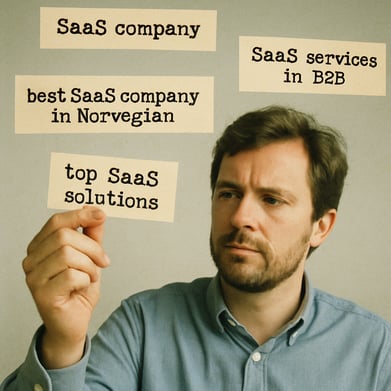
Key challenges in B2B keyword research
B2B companies often face specific limitations that complicate their paid search efforts:
- Too much B2C noise
An estimated 70–80% of all Google searches are consumer-focused. As a result, if your keyword targeting is too broad, you can quickly waste ad budget on people looking for personal solutions rather than business tools. This leads to low-quality website traffic and poor results. - Poor performance of predictive tools
For B2B niches standard tools like Google Keyword Planner or SEMrush often lack the data volume to accurately predict how many searches a term gets or the likely Cost-Per-Click (CPC). This makes initial budget planning difficult, requiring frequent adjustments in the first few months of the campaigns running. - Delayed results and missing data
B2B sales cycles can be long, and purchase decisions are collective. Because of this, it’s hard to tell which initial search keywords actually drove a final sale. To complicate matters, the tech world constantly changes, introducing new, highly specific search phrases (called "long-tail keywords") every month.
Our proven best practices for B2B keyword research and optimization
These are the approaches you can use – tested and refined across multiple industries to ensure consistently high-quality results.
Keyword planning for B2B campaigns
Step 1: Smart keyword planning
- Use multiple tools: Start with Google Keyword Planner to find your main topic areas, then use tools like SEMrush to find new, more specific ("long-tail") opportunities.
- Build exclusions early: Create a comprehensive list of negative keywords (terms you want to exclude) right away. This is your primary defense against showing ads to irrelevant B2C audiences.
Tip: Don't limit your traffic too much. B2B search volume is already lower, so focus on quality exclusion rather than aggressive filtering.
- Leverage AI strategically: AI tools (like ChatGPT) are not ideal for generating raw keyword lists. Instead, use them for topic discovery – checking if there are new pain points or industry verticals you haven't covered, and then validating those ideas with your data tools.
- Mine Google search itself: Type your main terms into Google and review the “People also search for” section. This section shows what users are genuinely exploring next and is a goldmine for new variations.
- Prioritize business intent: Focus on keywords that include modifiers like “for business,” “for SMEs,” or “for companies”. At the same time, exclude terms related to job-seeking, such as “career,” “jobs,” or “internship”
Step 2: Campaign setup in a data-limited world
Limited search volume makes planning difficult, but don't let a "zero" volume prediction deter you.
- Don't fear “0-Volume” keywords: Highly specific ("long-tail") or niche phrases often deliver the highest-quality traffic at a lower Cost-Per-Click (CPC). Even with low search counts, these terms convert better because they capture highly specific buying intent.
- Embrace conversational search: Users now type more natural, long-form questions. Around 15% of Google searches in 2024 were brand new (never searched before) and won't appear in standard predictive tools. We recommend running a broad, AI-driven campaign (often called AI Max or similar) alongside your main structured campaigns to "harvest" these emerging phrases.
- Add a budget buffer: Because Google's initial forecasts rely on incomplete B2B data, many advertisers underspend compared to the actual opportunity. We suggest adding roughly 30% on top of the predicted spending to ensure you capture hidden demand. You can only achieve more accurate budget allocation after the first three months, once enough campaign data has been collected.
Step 3: Intent-based optimization
In B2B, the sales cycle is long and every click is expensive, so every keyword must be intensely qualified:
- Structure campaigns by buyer intent (Funnel stage): Grouping keywords by why the person is searching helps you control budget and tailor ad messages.
Top Funnel Mid Funnel Bottom Funnel One of the trickiest groups to target due to lower intent. In many cases, we prefer to keep it as a separate campaign, so we can control the allocated budget and prevent it from cannibalizing spend from lower stages of the marketing funnel – which often happens simply due to higher search volumes.
Use audience signals to help educate the algorithms about your target audience.
Can be combined into the same campaign as bottom-funnel ad groups. However, keep in mind while writing ad copies that intent here is different – people at this stage will require more convincing messaging and proof of value.
Optimize this campaign for volume with modified broad or phrase match types.
If there is enough traffic and conversion volume, these can be separated into standalone campaigns with target CPA or target ROAS bidding strategies. However, in most B2B cases, volume is limited – so we keep them together with mid-funnel search terms to maintain efficiency. Keywords can include:
“How to choose…”
“Best software for…”Keywords can include:
“Vendor”
“Provider”
“Platform”
“Solution”Keywords can include:
“Pricing”
“Demo”
“Implementation”
“Integration with [tool]” - Manage industry jargon: B2B audiences use niche terms that algorithms can misinterpret. The best solution is to manually review your Search Term Reports (STRs) weekly to identify irrelevant jargon, then continuously update your negative keyword lists. You must stay close to your client’s or company's business to understand their specific language.
- Track meaningful "soft" conversions: Many valuable keywords won't immediately lead to a direct sale but are crucial steps in the long B2B journey. To avoid cutting them prematurely, track soft conversions – smaller, high-intent actions like a long session duration, visits to a pricing page, or a whitepaper download. These signals reveal traffic quality, not just simple volume.
Summary
Keyword research and STR analysis in B2B require more precision, patience, and contextual understanding than in B2C. It’s not just about finding search volume – it’s about decoding the intent, language, and value behind every query.
By combining data-driven methods with human insight, you can uncover high-intent keywords others overlook, filter out irrelevant traffic, and maximize your return on investment (ROI) at every stage of the buyer journey.
If you’re a B2B business owner, marketing manager, or agency partner looking to strengthen your Paid Search performance, we would love to collaborate. Together, we can refine your keyword strategy, unlock overlooked opportunities, and transform your campaigns into consistent lead-generation engines.
Download our checklist template