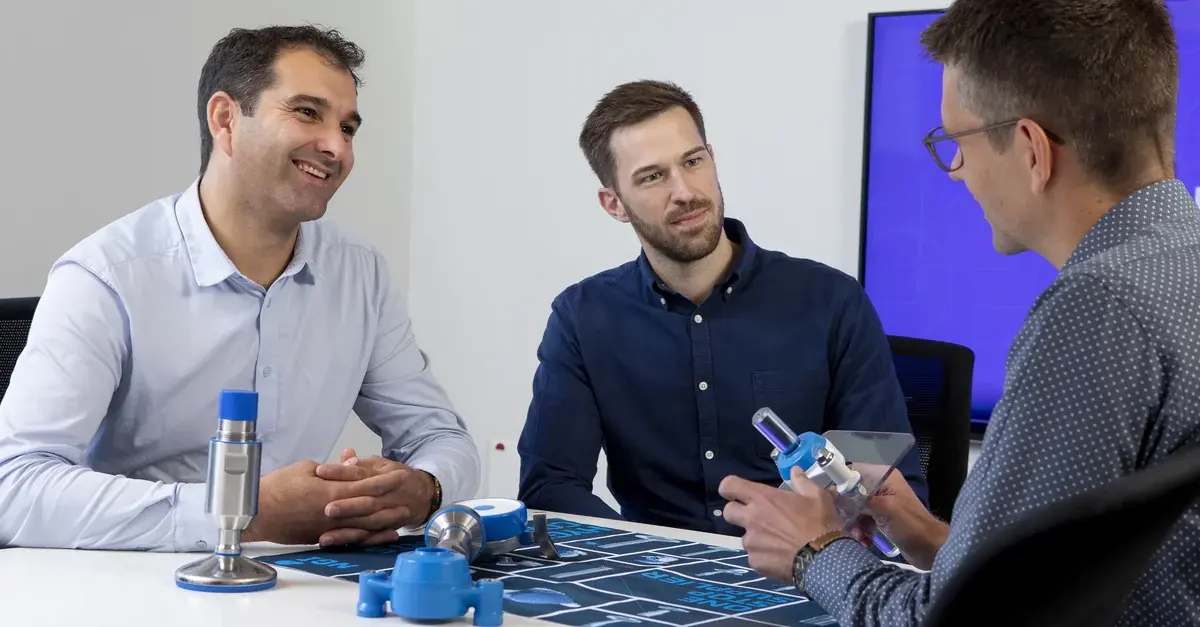
Merchant Services is the big engine inside Nets. Card terminals, acquiring agreements, and merchant relationships across Denmark, Sweden, Norway, and Finland. And until recently, Merchant Services had no real CRM. They had several legacy CRM systems, but they weren’t connected and they weren’t used as a CRM.
The challenge
Merchant Services is split into three segments by merchant size. Direct sells to the small merchants, SME to the mid-market, Large Key Accounts (LAKA) to the large enterprise accounts. And all three exist in four countries: Denmark, Sweden, Norway, and Finland.
So this was not just one team's process that needed fixing. It was twelve. All of them had to land in the same portal, working the same way, reporting on the same numbers.
This meant that Nets MS had no single source of truth. Sellers kept their own spreadsheets, marketing worked in a separate system, and the most valuable knowledge lived in people's heads. Want to know the status of a merchant deal? Ask the person who owns it. If that person leaves, the history of the interactions risks leaving with the person.
There was no shared process either. Each sales team qualified, followed up, and reported its own way, in its own software. LAKA in one tool, the partner team in another, calls running through something else again. Reporting got assembled afterwards in Power BI, which tells you what happened but never what is happening.
The solution
Nets needed a setup that could handle the complexity of the organisation e.g. multiple teams, multiple countries, and multiple pipelines. This was an opportunity to build a shared setup that embraces Nets Nordic’s sales philosophy.
Mapping first, building second
Before configuring anything, every team was walked through their future workflow. Here is a sales pipeline; can you see yourself selling in this? Here is a lead pipeline; does this match how work actually reaches you? Every market and every segment went through it, and the model changed when the answer was no.
Certain nuances only became visible during those collaborative sessions. Retention did not fit a normal sales pipeline, so dedicated retention pipelines were designed together with the team that owns them. Lead routing needed real Ideal Customer Profile (ICP) definitions underneath it, which meant Nets had to agree internally on revenue bands, employee counts, and terminal volumes before a single lead could be sent to the right country and the right segment.
A head start from the e-commerce side
Nets e-commerce had been running HubSpot for years, with a mature setup and years of learnings. And this was used as a starting reference. Proven routing logic, proven pipeline structure, proven reporting, all available on day one instead of being invented from scratch.
Where Merchant Services worked differently, and it often did, the model was rebuilt rather than forced.
An internal champion who understood the platform
A lot of what worked came down to Net’s internal project management led by Cajsa Malmstrøm, Commercial Project Coordinator. Cajsa is working inside the Nets team and built genuine HubSpot depth as the project went on. Rather than simply translating requirements, her understanding of both internal operations and the platform's capabilities allowed her to pinpoint specific HubSpot features that could streamline, automate, and elevate how the teams worked, ensuring the build served where the business was heading rather than where it had been.
What got built
- Advanced lead rotation across four countries and three segments, so leads land with the right team automatically.
- A custom object setup carrying account plans, retention cases, and partner tracks, with the objects talking to each other instead of sitting in isolation.
- Backend sync, so terminals, acquiring agreements, and operational data live where the sellers already work.
- Reporting moved into HubSpot across sales, retention, account plans, and adoption, so users stop leaving the system to find out how they are performing.
One portal for all of Nets Nordics
With the Merchant Services portal live and working, the existing e-commerce portals were migrated into it. So one portal, one way of working, across the entire group.
Malle Uldal
Head of Campaigns and Commercial Management, Nordics at Nets
The results in numbers
- The second-largest HubSpot portal in the Nordics. Around 400 active users across Merchant Services and e-commerce, roughly 320 of them on sales and service seats.
- Four markets, three segments, 12 sales pipelines in one portal, with automated routing between them.
- Two business areas merged into one portal. Merchant Services and e-commerce were separate business units with separate systems, reporting, and ways of working. They now sell, report, and hand over within the same setup.
- One consolidated tool stack. Closing down legacy systems was part of the business case for the new portal.
- One source of truth where there was none, with reporting leadership can act on instead of reassembling.
The collaboration today
The Merchant Services implementation was the starting point. It became the foundation for bringing all of Nets Nordics, Merchant Services, and e-commerce into one portal, with shared sales processes, marketing efforts, and reporting.
With more teams, countries, and processes in the same setup, the complexity keeps growing, and so does the work. The focus has now moved to adoption and refinement. Routing is being automated as the data builds up, reporting keeps expanding, and nurture flows are being rebuilt around intent and lead scoring.
Some of the early choices are already being adjusted, because six months of real use teaches you things no workshop can. Nets keeps growing and changing how it sells, and Helion works closely with the Nets team to keep the portal moving with those ambitions. A HubSpot portal this size is never finished. It just keeps getting better at matching the business.
About Nets Merchant Services
Nets Merchant Services is the merchant-facing arm of Nets Nexi, delivering payment solutions and acquiring agreements across Denmark, Sweden, Norway and Finland, from small direct merchants to large Nordic enterprise accounts.
Building something at this scale, or cleaning up after something that grew faster than its setup?